

According to reports from L'Équipe, the battle for this year's Ballon d'Or is expected to be exceptionally fierce. Historically, winners have also lifted the trophy by the slimmest of margins, sometimes by just a single point. L'Équipe looked back at the five closest coronations in Ballon d'Or history.
1996: Sammer Edges Out Ronaldo by 1 Point
This stands as the smallest point margin between the top two finishers in Ballon d'Or history. Just the year prior, the award had opened up to all players active across the European continent, regardless of nationality. European champion and German Footballer of the Year Matthias Sammer went up against "O Fenômeno" Ronaldo, who was charging toward the European Golden Shoe with Barcelona. In the end, Sammer finished with 144 points to Ronaldo's 143, separated by just one point. Ronaldo received more first-place votes, 16 to 13. The final gap was 0.13%—tiny yet monumental, representing the distance between the victor and the runner-up.
2019: Messi Edges Out Van Dijk by 7 Points
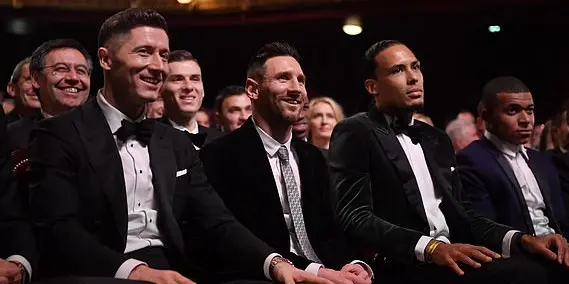
Messi's closest triumph did not come against Cristiano Ronaldo. In 2019, Liverpool captured the Champions League (defeating Tottenham 2-0 in the final), finished as Premier League runners-up, and were poised to capture their first top-flight championship since 1990 the following year, giving Virgil van Dijk ample reason to believe in his chances. Yet the Dutchman came up against Messi, the La Liga champion and La Liga top scorer, ultimately falling short by the narrowest of margins. Back then, 100 jurors cast ballots (compared to just 16 in the inaugural 1956 edition); Messi earned 686 points to Van Dijk's 679 points, a margin of just 7 points. At 24.36% to 24.11%, the 0.25% gap was the second-smallest percentage margin since 1996.
1966: Charlton Wins on Voting Discrepancies
Thirty years before Sammer, Bobby Charlton also edged out Eusébio by a single point. At that time, there were fewer jurors (22) and fewer points to distribute: the Englishman collected 81 points to Eusébio's 80, a 0.30% gap. The legendary Manchester United midfielder, who lifted the World Cup with the Three Lions, did not owe his victory to the English juror, who did not even include him in his top five, voting instead for compatriots Ball, Moore, and Hurst. Eusébio, who led Portugal to a third-place finish and claimed the World Cup Golden Boot with 9 goals, missed out on the chance to match Alfredo Di Stéfano, who was the only two-time winner at the time.
1972: Beckenbauer Faces Domestic Competition
In 1977, Michel Platini finished third, 4 points behind the winner, Denmark's Allan Simonsen. But 1972 was even tighter and denser, with the winner decided among three players from the same nation following West Germany's 3-0 victory over the Soviet Union in the European Championship final. Franz Beckenbauer claimed his first Ballon d'Or with 81 points, finishing 2 points ahead of teammate Gerd Müller and Borussia Mönchengladbach midfielder Günter Netzer. The Dutchman Johan Cruyff finished fourth with 73 points, having been ranked first 3 times and second 9 times. Exceptionally tight indeed.
2024: Rodri Prevails Over Real Madrid Contenders
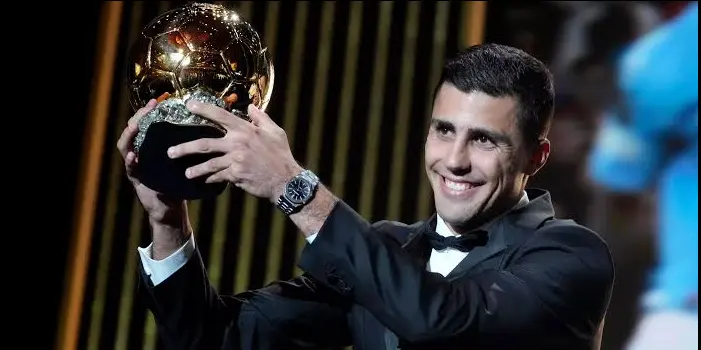
In 2024, Real Madrid won La Liga with only a single defeat and captured the Champions League, placing four players in the top four: Dani Carvajal in 4th, Jude Bellingham in 3rd, and Vinicius Junior in 2nd, claiming 1,129 points and 17.02% of the votes. However, that was not enough to defeat Rodri: the Manchester City midfield anchor, Premier League champion, and European Championship winner with Spain collected 1,170 points and 17.64% of the vote, 0.62% ahead of Vinicius. Having suffered a torn anterior cruciate ligament in his right knee in September, Rodri bravely took the stage on crutches to receive the trophy.